



Casino Payment Methods in Canada: Interac, E-Transfer and Crypto Compared
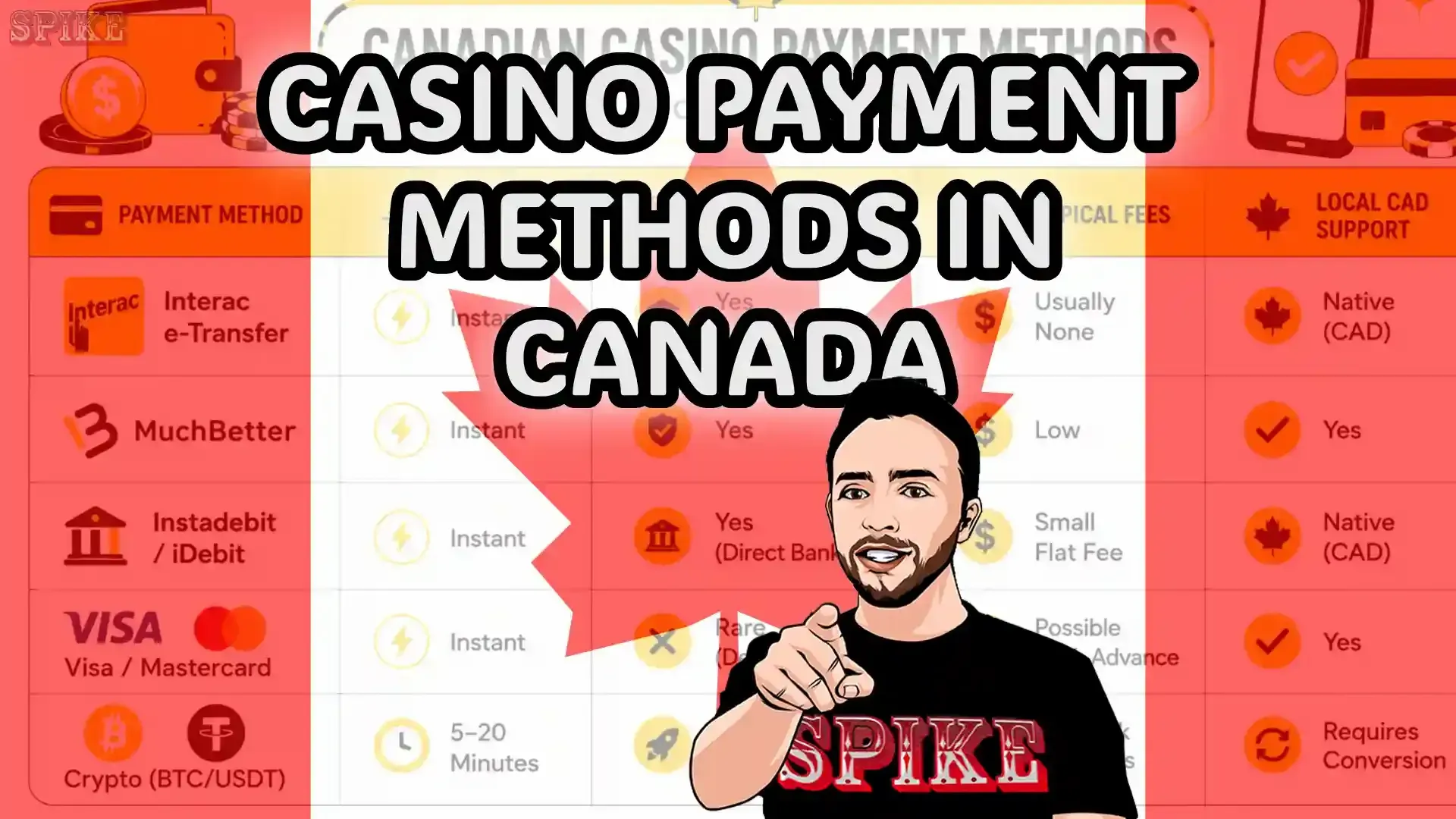
If you play at an online casino in Canada, you will run into three main ways to move money: Interac based options (including e-transfer), cards, and crypto. Each works differently at deposit and, more importantly, at withdrawal. This guide lines them up side by side so you know what to expect before you fund an account, not after you are waiting on a payout.
How Canadians Fund an Online Casino Account
Most Canadian-facing operators, whether they hold an AGCO/iGaming Ontario licence for the Ontario market or an offshore licence used elsewhere in the country, offer a similar core menu: Interac Online or Interac e-transfer, Visa/Mastercard debit and credit, a handful of e-wallets, and increasingly, cryptocurrency. Bank wire still exists for larger transactions but is slow and mostly used as a fallback.
The method you pick affects three things: how fast the money lands, what it costs you, and how quickly you can get it back out. Deposits are almost always fast regardless of method. Withdrawals are where the differences show up.
Interac and E-Transfer: The Canadian Standard
Interac is the payment rail Canadian banks use for direct online transfers, and it comes in two flavours at casinos:
Interac Online, which works like an instant online debit payment straight from your bank account.
Interac e-transfer, where you send funds using your email or phone number linked to your bank, similar to how you'd pay a friend back for dinner.
Both are widely supported because they are familiar, tied directly to a Canadian bank account, and generally trusted by players who are wary of handing card details to an operator. Deposits typically post quickly. Withdrawals back to Interac e-transfer are often positioned as one of the faster options, but the actual time to see funds depends on the operator's internal processing and verification steps, not just the payment rail itself, with published operator estimates ranging from within eight hours after internal review to 1–3 days overall.
Credit and Debit Cards
Visa and Mastercard remain common, largely out of habit. Deposits are instant in most cases. Card withdrawals, however, tend to be one of the slower paths back to your bank, since card networks and issuing banks add their own processing time on top of whatever the casino requires, with published timelines ranging from 1–4 hours at some operators to 3–5 business days of internal processing plus up to 24 hours for Visa Fast Funds at others. Some operators also cap how much of a card deposit can be refunded to the same card, redirecting the rest to bank transfer.
Crypto Deposits: What's Different
A growing number of sites, particularly in the offshore/grey market space outside Ontario, accept Bitcoin, Ethereum and stablecoins. The appeal is speed and, for some players, privacy: a confirmed on-chain transaction can move faster than a traditional bank rail, and crypto withdrawals are not tied to a bank's business hours, although timing varies by network and operator: Ethereum blocks are produced about every 12 seconds, Bitcoin transactions usually begin confirming within 10–20 minutes, and casino withdrawals may be processed immediately but can take longer if manual checks or network congestion apply. The trade-off is volatility if you hold a fluctuating asset like Bitcoin rather than a stablecoin, plus network fees that vary with blockchain congestion.
It's worth being clear-eyed here: a fast crypto payout doesn't offset the fact that the games themselves are still pure chance. Speed of payment method has nothing to do with your odds of winning.
Comparison Table: Speed and Fees by Method
| Method | Typical deposit speed | Typical withdrawal speed | Typical fees |
|---|---|---|---|
| Interac Online | Not available; the service was decommissioned in 2024 | Not available | N/A |
| Interac e-transfer | Instant to 30 minutes | 1–4 hours after approval; operator review may add up to 1 business day | Usually $0; the bank may charge a sending fee |
| Visa/Mastercard | Instant | 1–5 business days; some operators process domestic card withdrawals within 1–4 hours | Usually $0 from the casino; the card issuer may treat gambling deposits as cash-like transactions and charge fees and immediate interest |
| Crypto (BTC/ETH/stablecoin) | Seconds to approximately 1 hour, depending on the network and required confirmations | Minutes to a few hours after approval; manual checks or network congestion may cause delays | Network/miner or gas fee; varies by blockchain and congestion |
| Bank wire | 1–5 business days | 1–5 business days | Casino fees are often $0, but bank and intermediary charges of approximately C$15–C$50 or more may apply |
In practice, speed and fees vary significantly by operator, by your specific bank or crypto exchange, and by which jurisdiction licenses the site (an AGCO/iGaming Ontario - licensed operator may process differently than an offshore operator licensed elsewhere). Always confirm the current numbers on the operator's own payments page before you rely on them, and expect fees to differ for deposits versus withdrawals even within the same method.
Withdrawal Times: What Actually Slows You Down
Two separate clocks run on every withdrawal request:
The operator's internal review. This includes identity verification (KYC), checking that any wagering requirement on a bonus has been met, and a manual approval step that some operators run on larger withdrawals.
The payment rail itself. Once approved, the money still has to travel through Interac, the card network, the bank, or the blockchain.
A method advertised as "instant" only covers the second clock. If your account hasn't finished verification, even the fastest payment rail won't get you paid quickly. This is one of the most common reasons players feel a withdrawal is "stuck" when the actual cause is an incomplete verification step on their end.
What to Check Before You Deposit
Minimum and maximum limits for both deposits and withdrawals, since these can differ sharply by method.
Whether the method is also available for withdrawal. Some deposit-only options (certain prepaid cards, for instance) cannot be used to cash out.
The operator's licensing jurisdiction. Ontario players can only access the regulated AGCO/iGaming Ontario market; outside Ontario, players commonly use offshore sites licensed elsewhere, which are not overseen by a Canadian provincial regulator. Check the licence before you deposit anything.
Any wagering requirement attached to a deposit bonus, since this affects when funds actually become withdrawable, regardless of payment method. You can compare the terms commonly found in Canadian casino welcome offers before choosing a promotion.
Currency handling. Look for accounts and payouts in C$/CAD to avoid conversion fees.
None of this changes the basic math of the games: RTP and volatility are long-term theoretical figures, not something a fast payment method improves.
A Word on Responsible Play
Payment speed is a convenience question, not a strategy. Treat any money you deposit as money already spent on entertainment, set a limit you're comfortable losing before you start, and use tools like deposit limits or self-exclusion if you want more control over your play. You must be of legal gambling age in your province (18 in Alberta, Manitoba and Quebec; 19 elsewhere) to play at any of these sites. If gambling stops feeling like entertainment, resources like the Responsible Gambling Council, provincial problem-gambling helplines, and for Ontario players ConnexOntario are there to help — ConnexOntario is available 24/7 at 1-866-531-2600 or by texting CONNEX to 247247, while the Responsible Gambling Council maintains a province-by-province directory of Canadian support services.
FAQ
Is Interac e-transfer available at every Canadian online casino?
Availability depends on the individual operator and its licence; check the cashier page of the specific site before assuming it's supported.
Are crypto casino deposits legal in Canada?
Legality depends on the operator's licensing status and the province you're playing from; there is no single blanket answer for "Canada" as a whole. Confirm the operator's licence directly through the relevant provincial regulator, noting that FINTRAC states virtual currencies are not accepted at online gambling sites licensed to operate within Canada.
Why did my withdrawal take longer than the deposit?
Deposits are usually processed instantly by design, while withdrawals go through identity verification and bonus wagering checks before the payment rail even starts moving the money.
Do card withdrawals cost more than Interac?
Fee structures vary by operator; some absorb the cost, others pass on a percentage. Always check the operator's payments terms rather than assuming, because there is no standard fee difference and Ontario-licensed operators must disclose any player-account fees before a deposit or withdrawal.
Can I withdraw to a different method than I deposited with?
Many operators require withdrawals to return via the same method used for deposit, up to the deposited amount, for anti-fraud reasons; anything beyond that may go to a different method such as bank wire. Policies vary by operator; for example, bet365 states that authorized withdrawals are usually returned to the deposit method and may be sent by bank wire when that is not possible.
Does using crypto change my odds of winning?
No. Payment method has no effect on RTP, volatility or game outcomes, all of which are RNG-driven and independent of how you fund your account.
Are there fees just for depositing?
Some methods charge nothing on deposit but a fee on withdrawal, or vice versa; this is operator-specific and should be checked before you commit to a method, and Ontario-licensed operators must disclose all player-account fees before a deposit or withdrawal.
What's the safest payment method for a Canadian player?
"Safest" depends on what you're optimizing for: Interac ties transactions directly to your bank and is broadly familiar to Canadian players, while crypto offers speed but requires comfort with digital wallets and volatility. Neither removes the need to confirm the operator's licence first.