


Crash Games Explained: How Aviator, Spaceman and Provably Fair Multipliers Work
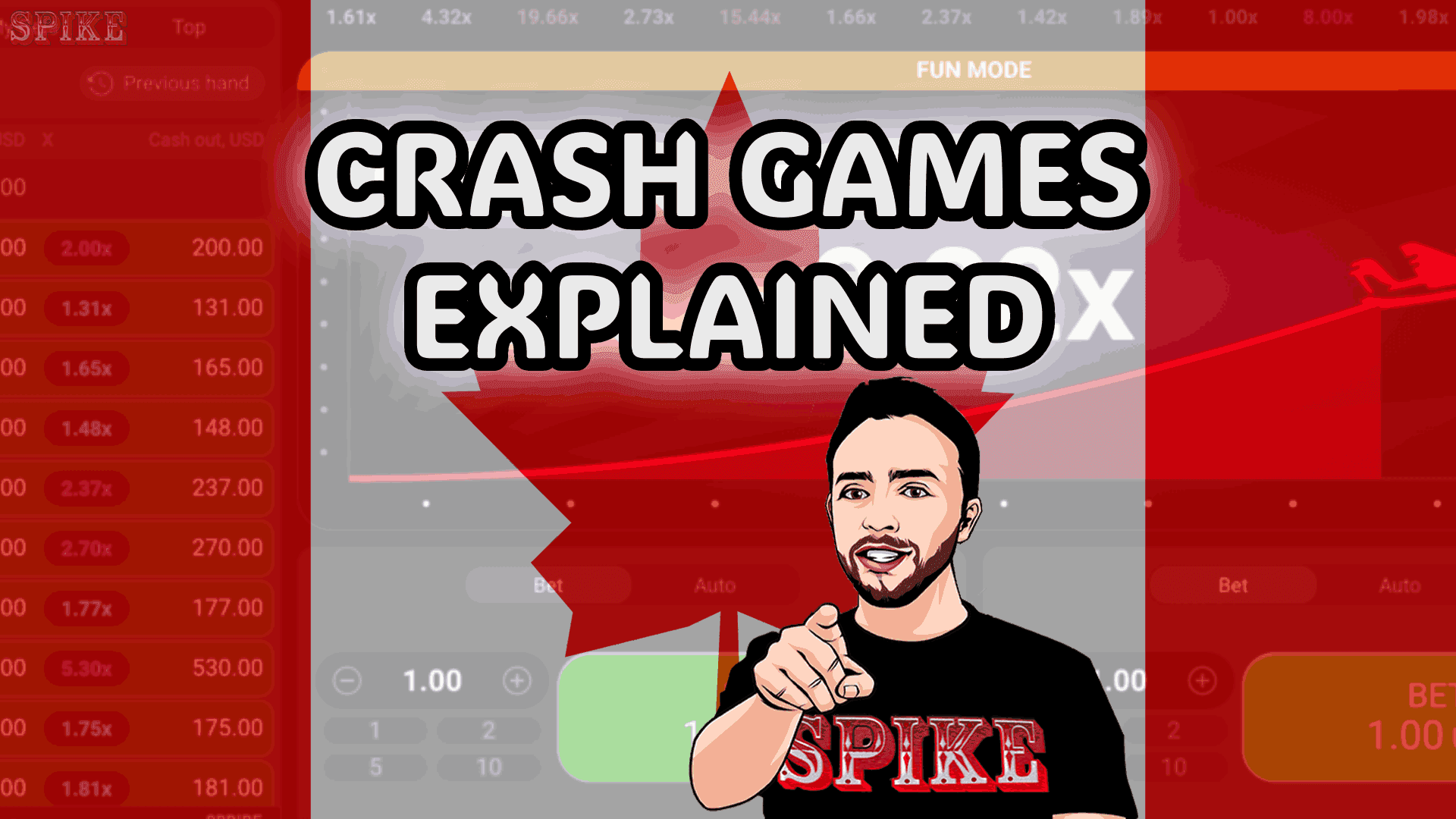
Crash games are one of the fastest-growing categories in online gambling, and if you have ever watched a plane take off in Aviator or an astronaut climb in Spaceman, you already understand the basic hook: a multiplier rises, and you decide when to cash out before it "crashes." This guide breaks down how these games actually work under the hood, what provably fair really means, how the main titles compare, and why cash-out timing is a personal risk decision rather than a system that beats the math.
In this guide:
- What Is a Crash Game?
- How the Multiplier Works
- Provably Fair: Verifying the Math Behind the Crash
- How Does Aviator Work?
- Spaceman and Other Popular Crash Titles
- Comparing Crash Games
- Cash-Out Timing: A Risk Choice, Not a System
- Common Mistakes to Avoid
- Are Crash Games Available to Canadian Players?
- FAQ
1. What Is a Crash Game?
A crash game is a simple, fast-paced betting round built around a single rising number: the multiplier. You place a bet before the round starts, the multiplier climbs from 1.00x, and at some point, determined by the game's algorithm, it "crashes." If you cash out before that happens, your bet is multiplied by whatever value was showing at the moment you clicked. If the round crashes before you cash out, you lose the stake.
Unlike a video slot, there are no reels, symbols or paylines. The entire game is one animated number and one decision: when to take your win. That simplicity is part of the appeal, and it is also why crash games get grouped with other fast, social, round-based formats rather than traditional slots.
Rounds usually last a few seconds to under a minute. Players in the same room typically see the same multiplier climb in real time, and a live bet feed often shows what others staked and when they cashed out. This social layer makes the format feel different from a solitary slot session, even though the outcome is still generated randomly.
2. How the Multiplier Works
Each crash round is powered by a random number generator (RNG) that determines, before the round is shown to players, the exact multiplier at which it will end. Players do not see this number in advance; the animation simply reveals it as the multiplier climbs.
A few important technical points, all standard for RNG-based games:
- Rounds are independent. A crash at 1.2x has no bearing on the next result, so a sequence of low outcomes does not mean a high multiplier is "due."
- The crash point follows a probability distribution, not a fixed pattern. Low multipliers are far more common than very high ones, which is why big results attract attention but should not be treated as typical.
- The house edge is built into the distribution itself. The exact figure varies by title, and studios do not always publish it in the same way slot providers publish RTP. Where a theoretical return is stated, it is a long-term statistical value rather than a guarantee for any session.
3. Provably Fair: Verifying the Math Behind the Crash
Many crash games, including Aviator, use a system called provably fair. This is a cryptographic method that lets a player verify, after the fact, that the round's outcome was not altered once it started.
In simple terms, before a round begins, the game generates a hashed value representing that round's result. You cannot read the result from the hash, but once the round ends, the game reveals the original value. You can then run it through a public verification tool to confirm that it matches the value committed before play began. A match shows that the result was fixed in advance rather than changed in response to players' bets.
Provably fair does not make a game easier to beat or remove its house edge. Its purpose is transparency: it gives players a way to check the integrity of an individual round. For a fuller technical walkthrough, read how provably fair systems work.
Not every crash game offers public provably fair verification. Some rely instead on an RNG certified by the operator or a third-party testing laboratory, so the verification method should be checked in the game's information panel.
4. How Does Aviator Work?
Aviator, developed by Spribe, is the title most responsible for popularizing the crash format worldwide. A small plane takes off from the bottom of the screen while a multiplier climbs. You bet before takeoff and must cash out before the plane flies off screen; any bet that has not been collected when the round ends is lost.
Aviator's format includes a few recurring features worth knowing:
- Dual betting. Many versions let you place two separate bets in the same round, so you can cash one out early and let the second continue, or vice versa.
- Auto cash-out. You can set a target multiplier in advance so the game collects the bet automatically if that value is reached.
- Live bet feed. A panel shows other players' stakes and cash-outs in the shared round.
- Provably fair verification. Players can check that a round's crash point was committed before betting opened.
Aviator's exact RTP and crash-point distribution are proprietary to Spribe and may vary by operator configuration. Any percentage shown for a specific version should therefore be checked in that version's game information rather than treated as a universal figure.
5. Spaceman and Other Popular Crash Titles
Spaceman, developed by Pragmatic Play, follows the same core mechanic with a space-themed presentation: an astronaut rises instead of a plane, and the multiplier climbs until the astronaut "flies away." Pragmatic Play built Spaceman as an alternative within the same category, and it is widely offered by operators that carry the provider's catalogue.
Beyond Aviator and Spaceman, the crash category has expanded quickly. Studios such as SmartSoft Gaming and BGaming have developed their own versions, sometimes adding side mechanics such as bonus zones, additional multipliers or themes built around rockets, balloons and jets.
6. Comparing Crash Games: Provider, Mechanic and Provably Fair
The table below compares how a few well-known crash titles are typically structured.
| Game | Provider | Core Mechanic | Provably Fair |
|---|---|---|---|
| Aviator | Spribe | Plane ascends, cash out before flight | Yes |
| Spaceman | Pragmatic Play | Astronaut ascends, cash out before departure | Yes |
| JetX | SmartSoft Gaming | Jet ascends, cash out before crash | No |
| Aviamasters | BGaming | Plane ascends over a grid with bonus multiplier zones | No |
A point the table cannot show is that provably fair verification only confirms that a round was not altered after betting opened. It does not describe how frequently a title produces high multipliers, which depends on that game's underlying distribution.
Want to try a few titles before reading further comparisons? You can browse our free demo library to explore crash games in demo mode, where no real money is at risk.
7. Cash-Out Timing: A Risk Choice, Not a System
This is the part of crash games most commonly oversold elsewhere, so it deserves a direct answer: there is no cash-out pattern that creates an advantage over the game's built-in math. Choosing 1.5x, 2x or 5x changes the balance between how often a target may be reached and how much a successful cash-out pays. It does not turn the target into a winning system.
A few honest ways to think about it:
- Lower cash-out targets are reached more often but pay less. Exiting around 1.2x to 1.5x produces a smaller return on a successful round.
- Higher targets pay more but are reached less often. Waiting for 5x or 10x means accepting greater volatility and more losing rounds.
- Auto cash-out supports consistency. A preset target can reduce impulsive, in-the-moment decisions, but it cannot improve the expected return.
- Past results are not a forecast. A run of early crashes or high multipliers provides no reliable signal about the next round.
Choosing when to cash out is therefore a personal decision about risk and volatility, not a method for beating the RNG. Claims that a particular sequence or target guarantees profit misrepresent how the game works.
8. Common Mistakes to Avoid
- Chasing losses by increasing bets after a crash. Raising the stake to recover a previous loss only increases the amount at risk.
- Treating a streak as a signal. Recent multipliers do not reveal what the next result will be.
- Assuming provably fair means "beatable." Verification demonstrates the integrity of a round; it does not give the player a mathematical advantage.
- Ignoring the auto cash-out setting. A preset exit point may help you follow a limit you chose before the round began.
- Skipping the demo mode. Use it to browse our free demo library and become familiar with a title's interface and pacing before considering real-money play. Demo results should not be used to forecast paid outcomes.
9. Are Crash Games Available to Canadian Players?
Canada does not have a single national gambling regulator; oversight is provincial. In Ontario, operators regulated by the AGCO and conducted and managed by iGaming Ontario operate within the provincial framework. Outside Ontario, Canadian players may encounter offshore-licensed operators, including sites regulated in jurisdictions such as Kahnawake or Malta. In every case, check the specific licence held by the operator rather than relying on a broad claim that a site is simply "legal in Canada."
You must be of legal gambling age in your province to play: 18 in Alberta, Manitoba and Quebec, and 19 in the other provinces and territories.
Crash games are entertainment with a real cost, not a way to earn income. Set a spending limit you can afford to lose before you start and treat that amount as already spent. Deposit limits, time limits and self-exclusion tools are available through many regulated operators and provincial programs; see our responsible gambling guide for Canadian players for more information.
In Ontario, BetGuard's centralized self-exclusion service can be reached at 1-833-776-7171. ConnexOntario provides free, confidential support 24 hours a day at 1-866-531-2600, by texting “CONNEX” to 247247, or through its online services. Players elsewhere in Canada can use the Responsible Gambling Council's Find Gambling Help directory to locate support in their province. If gambling stops feeling like entertainment, stop playing and contact an appropriate support service.
For more on how these titles fit into the wider live and instant-win category, explore our casino guides and practical tips and live game statistics.
10. FAQ
What is a crash game?
It is a short casino round in which the potential payout increases with a rising multiplier. The bet must be collected before the randomly determined end of the round.
How does Aviator work?
Players stake before the plane launches and may collect while the multiplier is rising. Any uncollected stake is lost when the flight ends.
Is Spaceman the same game as Aviator?
No. It belongs to the same crash-game category and uses a similar rising-multiplier format, but it is a separate title made by Pragmatic Play rather than Spribe.
What does provably fair mean in a crash game?
It is a commitment-and-reveal process that allows the player to check that the result disclosed after a round matches the cryptographic value committed beforehand.
Does cashing out at a specific multiplier improve my odds?
No target removes the house advantage. A lower target trades a smaller payout for a greater chance of being reached, while a higher one does the opposite.
Can a crash game be "due" for a big multiplier after several low rounds?
No. The visible history may look streaky, but it does not make a particular outcome more likely in the following round.
Are crash games legal in Canada?
Availability and regulatory status depend on the province and the operator. Ontario has a provincial regulated market, while players elsewhere may see operators licensed in other jurisdictions. The relevant licence should always be checked directly.
What is the legal age to play crash games in Canada?
The minimum age is 18 in Alberta, Manitoba and Quebec, and 19 in the remaining provinces and territories.
Is there a house edge in crash games?
Yes. It is embedded in the probability distribution used to generate the crash point, although the precise theoretical return can differ between titles and configurations.
Can I try crash games for free before betting real money?
Where a demo is available, it can help you learn the controls and pace without staking money. It should be treated as a practice environment, not evidence of what a paid session will produce.
Do auto cash-out settings help me win more?
They can help you follow a predetermined exit rule and avoid delayed reactions, but they do not change the game's expected return.
What's the difference between a crash game and a slot?
A slot presents outcomes through reels, symbols and paylines. A crash game presents one shared, rising multiplier and asks the player whether to collect before the round ends; both formats use random outcome generation.