


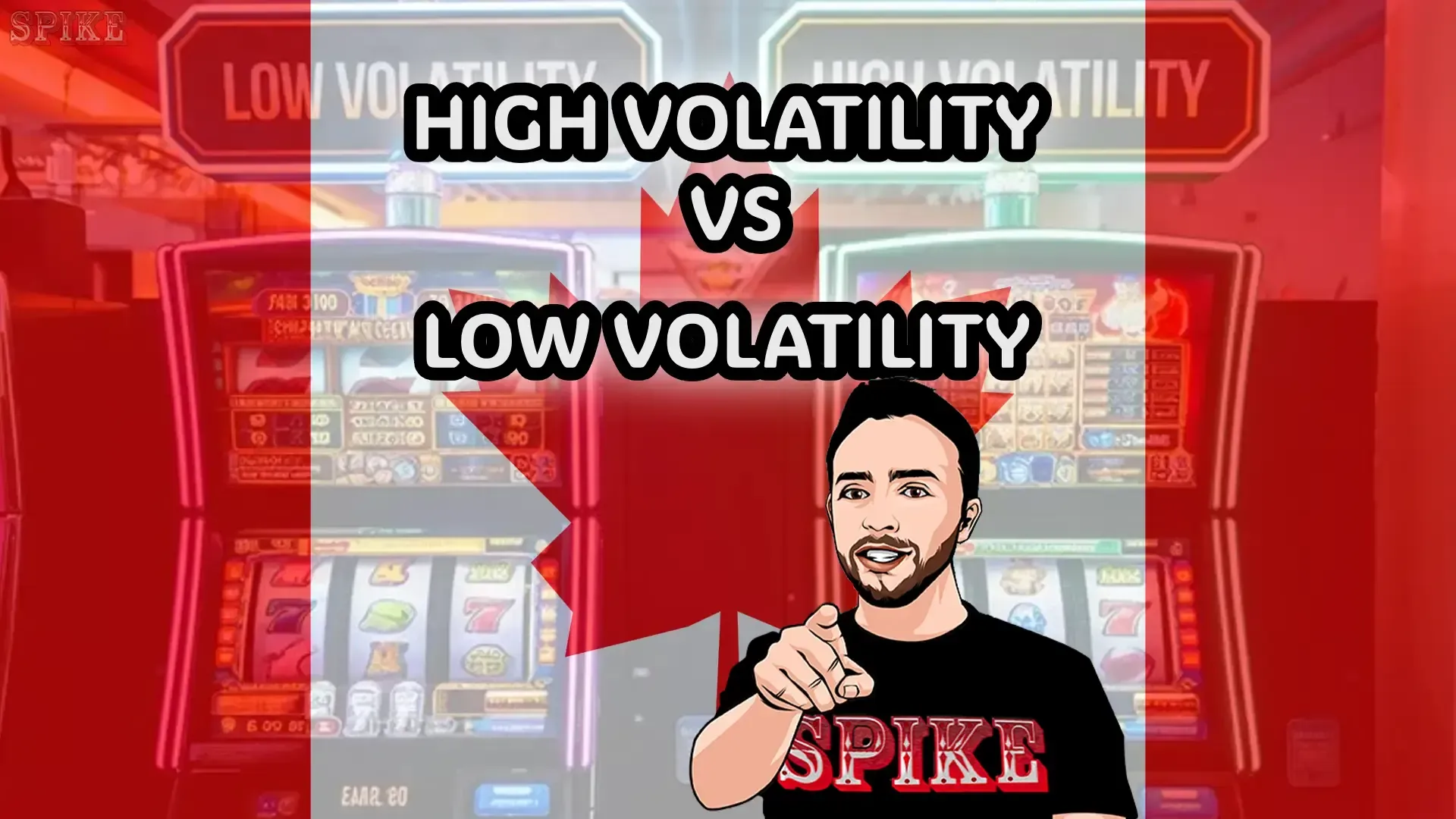
High Volatility vs Low Volatility Slots: Which Is Right for You?
Volatility is the single most practical piece of information a slot tells you before you spend a dollar. It shapes how a session feels, how long your bankroll lasts, and how often you see a return on the reels. Yet it is probably the most misread stat in online slots, with players assuming that "high volatility" means "pays more." It does not. This guide cuts through that confusion, compares both types honestly, and helps you pick the right fit for your budget and style.
What Volatility Actually Measures
Volatility (also called variance) describes the pattern of how a slot distributes its payouts over time. It is a theoretical value, built into the game's math, and it does not change from spin to spin.
A high-volatility slot pays out less frequently but tends to deliver larger amounts when it does pay. Sessions can run long with minimal returns, punctuated by occasional big hits.
A low-volatility slot pays out more regularly, but the individual amounts are smaller. Your balance moves up and down in smaller increments, and your money tends to last longer across a given number of spins.
Medium volatility sits between the two, balancing frequency and size. Most slots in practice land somewhere on a spectrum rather than at a fixed point.
One important clarification: volatility tells you about payout distribution, not about the total amount returned over millions of spins. That figure is RTP (Return to Player). The two stats measure different things and should never be confused. A high-volatility slot can have the same theoretical RTP as a low-volatility one; the difference is in the rhythm, not the total.
For a full breakdown of how volatility is calculated and what the numbers mean, see our how slot volatility works guide for Canadian players.
Head-to-Head: The Key Differences
| Feature | High Volatility | Low Volatility |
|---|---|---|
| Win frequency | Lower | Higher |
| Typical win size | Larger (when wins land) | Smaller, more consistent |
| Session length on same bankroll | Shorter (more variance) | Longer (steadier burn) |
| Bonus/feature triggers | Less frequent | More frequent |
| Recommended bankroll | Larger | Smaller |
| Emotional intensity | High (swings) | Lower (steadier) |
Notes on the table above: "larger" and "smaller" are relative and theoretical. No volatility category guarantees a specific payout in any session. Session length depends on bet size, the specific slot's math, and the randomness of results in that session. These are tendencies across large sample sizes, not predictions.
RTP vs Volatility: The Difference That Matters
This is where a lot of players go wrong. RTP and volatility are often talked about as if they are the same thing. They are not.
RTP is the percentage of all money wagered that the slot theoretically returns to players over millions of spins. A slot with a 96% theoretical RTP declared by the provider returns $96 for every $100 wagered across that enormous sample. It says nothing about what you will see in one session or one hundred sessions.
Volatility describes the shape of how that 96% is distributed. Two slots can share an identical 96% theoretical RTP, one paying small wins on nearly every third spin, the other paying almost nothing for 200 spins and then landing a 500x.
The practical takeaway: check both stats separately. A high-RTP, high-volatility slot can drain a small bankroll fast even though it theoretically returns more over time. A lower-RTP, low-volatility slot can keep a modest budget alive for a long session. Always verify RTP figures on the provider's official game page or in the in-game info panel, as some operators run a reduced-RTP version; check the game info before you play.
Budget and Session Length: The Real Deciding Factor
If there is a single practical rule for choosing volatility, it comes down to bankroll and time.
High volatility suits you if:
Your session budget is large enough to absorb a dry run before any significant payout materialises. As a rough principle, high-volatility slots work better with a bankroll of at least 100 to 200 times your stake per spin, because the gaps between meaningful wins can run that long. If you are playing at $1 per spin, you want $100 to $200 available for that session and should be comfortable watching that balance drop substantially before anything comes back.
You also need patience. High-volatility sessions can test it. Players who chase losses or raise stakes to recover after a dry run are in the most dangerous position with this type of slot, because the math does not suddenly shift in their favour after a cold streak.
Low volatility suits you if:
You are working with a smaller budget and want your session to last. Low-volatility slots give more frequent feedback, which keeps the experience engaging across a longer play period. If you are exploring a new slot in demo mode, a low-volatility title gives you more hands-on time per virtual credit.
Low-volatility slots also tend to work better when you are using a bonus with wagering requirements, because the steadier returns help you work through the rollover without exhausting your balance in a few big swings.
How to Spot Volatility Before You Play
Providers do not always publish a clean "low / medium / high" label, but there are reliable ways to gauge it.
Check the paytable. Look at the top symbol payout relative to the base bet. If the top symbol combination pays 500x or more your stake, expect higher variance. Paytables with tight bands, where the best symbol pays 20x to 50x and even low-value symbols pay something meaningful, point toward lower volatility.
Look at the bonus trigger mechanics. Slots where the free-spins bonus triggers on 3 scatters and those scatters appear frequently are usually lower volatility. Slots where the feature requires 4 or 5 scatters, or where the feature itself multiplies wins dramatically, are generally higher volatility.
Read the review. A well-written review will state the volatility and whether it was confirmed in play. SPIKE always tests in demo before writing, so the volatility classification in each review on spikeslotcanada.com reflects real play observation, not just the marketing copy.
Use demo mode. Free play is the most honest way to get a feel for a slot's rhythm before committing real money. Try 50 to 100 demo spins and pay attention to how often any win lands and whether the swings are dramatic. Our free slots section lets you do exactly that.
A Practical Example: Two Slots, Two Experiences
Rather than naming two slots in the abstract, it helps to see the contrast in play terms.
Take a high-volatility slot like Deadwood xNudge (NoLimit) RTP 96.03 – 96.06% and High volatility (extreme variance). This is a slot where sessions in demo can run 40 to 60 spins with minor returns, and then a nudge wild stacks a multiplier that lands something dramatic. The feature triggers are not frequent. The max win potential is substantial 13.950x. If you are playing at $0.50 a spin with $30, a long dry run can end your session before the feature shows up.
Compare that with a low-volatility slot like Fruit Shop (NetEnt) RTP 96.71% and Low volatility. Wins land regularly in the base game. The free-spins feature triggers at a reasonable rate. You will not see 500x in a single spin, but your $30 at $0.50 a spin lasts considerably longer, and you are rarely more than a few spins from some return.
Neither experience is objectively better. They are different games for different moods and budgets. See our dedicated review of Deadwood xNudge and Fruit Shop for the full breakdown of each.
Volatility and Casino Bonuses: What to Watch
If you are playing through a welcome bonus or free-spin offer, volatility choice matters more than usual. Bonus funds come with wagering requirements: you must play through the bonus amount a set number of times (typically 20x to 40x, depending on the operator's terms) before any winnings become withdrawable.
Low-volatility slots and bonuses: the steadier win frequency helps you grind through the wagering requirement without burning through your balance in a few bad spins. The tradeoff is that you are unlikely to hit a large multiplier that would produce a big cashout.
High-volatility slots and bonuses: one good session can produce significant winnings, but you can also exhaust the bonus balance in a dry run before completing the rollover. Some operators also cap the maximum bet allowed during wagering (commonly $5 per spin), and high-volatility slots can make that restriction hurt more when wins are rare.
Always read the full bonus terms on the operator's site before playing. Our best casino bonus section lists offers with key terms clearly stated. Check which games count toward the rollover and at what rate; some high-volatility slots are excluded or count at a reduced percentage.
Which Volatility Should You Choose?
There is no correct answer that holds for every player. The honest framing is that neither high nor low volatility slots pay more in the long run: both return according to their theoretical RTP over millions of spins, and RTP is set by the provider, not the volatility level.
The question to ask is: what kind of session do I want?
If you have a larger budget, enjoy the tension of a longer dry run, and find big single-hit moments more exciting than steady small returns, high volatility is the match. If you have a smaller budget, want your session to last, and find frequent small wins more enjoyable than long cold stretches, low volatility fits better.
For players exploring slots for the first time, low volatility is the more forgiving starting point, not because it pays more, but because it gives you more time on the reels to learn how a game works without your budget disappearing in a few spins. Our best high-volatility slots article is a good next read once you are comfortable with the distinction.
Responsible Gambling Note
Volatility affects the pace of your session, not whether you come out ahead. All slots are games of chance, powered by a Random Number Generator (RNG). No volatility level, betting pattern, or system changes the house edge or improves your long-term odds of winning.
Set a session budget before you play, one you are comfortable treating as entertainment spend, and stop when it is gone. Deposit limits, session limits, and self-exclusion tools are available at most licensed operators and through provincial programs. For support or information, contact the Responsible Gambling Council Responsible Gambling Council at +1 (416) 499-9800 or via their official contact page Contact RGC, or your province's problem gambling helpline (varies by province; for example Ontario uses ConnexOntario at 1-866-531-2600). Ontario players can also reach ConnexOntario at 1-866-531-2600 or text CONNEX to 247247.
You must be of legal gambling age in your province to play: 18 in Alberta, Manitoba and Quebec; 19 in all other provinces and territories.
FAQ
Does high volatility mean a slot pays out more than low volatility?
No. Volatility describes the distribution of payouts, not the total amount returned. Two slots can share the same theoretical RTP and have completely different volatility levels. High volatility means larger but less frequent wins; low volatility means smaller but more frequent wins. Neither type "pays more" over the long run.
What bankroll do I need for a high-volatility slot?
As a general guide, a session budget of 100 to 200 times your stake per spin gives you enough room to absorb the dry runs that high-volatility slots produce. At $1 per spin, that means $100 to $200 set aside for that session. Treat it as entertainment spend you are comfortable losing, not an investment you expect back.
Are low-volatility slots better for beginners?
They tend to be more forgiving as a starting point. The more frequent wins give you more play time per dollar, and the steadier rhythm makes it easier to learn a game's mechanics without your budget disappearing quickly. Demo mode is free and a great way to try any slot first.
Can I tell a slot's volatility before I play?
Often yes. Check the paytable (big gaps between top and low symbol values suggest higher volatility), look at how the bonus is triggered (rarer triggers and bigger multipliers suggest higher volatility), and read a reliable review that includes demo testing. Most providers also state volatility in the game's info panel.
Is medium volatility just a compromise, or is it a real category?
It is a real classification, and many popular slots land there. Medium-volatility slots aim to balance win frequency and win size, producing fewer extreme sessions in either direction. For many players, medium volatility offers the most comfortable day-to-day experience.
Which volatility is better when playing through a casino bonus?
Low-volatility slots generally work better for grinding through wagering requirements, because the steadier returns help you maintain your balance across the rollover. High-volatility slots can pay off big in one session, but they also carry a higher risk of exhausting the bonus balance before the requirement is met. Always check the operator's bonus terms for any game restrictions.
Does RTP change based on volatility?
Not directly. RTP and volatility are independent parameters set by the provider. However, some operators configure a reduced-RTP version of a slot. Always check the in-game info panel to confirm the RTP version running on the platform where you are playing; it may differ from the provider's standard figure.
How does a slot's hit frequency relate to its volatility?
Hit frequency measures how often any winning combination lands. Low-volatility slots tend to have higher hit frequencies (wins on, say, 1 in 3 spins); high-volatility slots tend to have lower hit frequencies (wins on 1 in 10 or fewer spins). The two stats are related but not identical: a slot can have a moderate hit frequency but still be high volatility if most of those wins are tiny and the big payouts are rare.